

A pressure regulator adjusts flow to control pressure at a selected point. Pressure-reducing regulators control downstream pressure; back-pressure regulators control upstream pressure. Selection starts with that duty and the pressure variation the process can accept as flow and supply conditions change.
Single-stage and dual-stage describe the number of pressure-reduction stages. Direct-operated and pilot-operated describe how the main valve is controlled. These are different classifications: the presence of a pilot does not by itself mean that the process fluid passes through two reduction stages.
In this article, we will explore the various types of pressure regulators, how they work, and the best applications for each, helping you make informed decisions when selecting the right regulator for your system.
What Is a Pressure Regulator?
A pressure regulator combines a sensing mechanism with a loading force and a throttling element. The arrangement responds to the controlled pressure, but its operating range and pressure-versus-flow behavior determine how closely it can hold the required setting.

source: FITOK
Components of a Pressure Regulator
A conventional mechanical regulator has three functional elements: sensing, loading and throttling. Their arrangement determines whether the device controls upstream or downstream pressure.
Sensing Element
The sensing element, often a diaphragm or piston, responds to the controlled pressure. A reducing regulator senses downstream pressure; a back-pressure regulator senses upstream pressure. Sensing may be internal or connected through an external control line, depending on the design.
Loading Element
The loading element supplies a balancing force, commonly from an adjustable spring or pressurized gas in a dome. A diaphragm or piston is the pressure-sensing element, not a separate category of loading source. Pilot-operated designs use the pilot to vary the loading pressure on the main actuator.
Throttling Element
The throttling element changes the flow area, commonly between a plug or poppet and a seat. Its movement adjusts inflow for a reducing duty or outflow for a back-pressure duty. A separate actuated valve with a transmitter and controller is another control arrangement; compare it in the pressure control valve vs regulator guide.
These elements work together through a force balance. Review the complete assembly and its operating data instead of assuming that every regulator provides the same pressure accuracy or response.
Types of Pressure Regulators
The categories below answer different questions: how many reduction stages are used, how the main valve is operated, and which side is controlled. Relief valves are included separately to explain the boundary between regulation and protective service.
1. Single-Stage Pressure Regulator

A single-stage pressure-reducing regulator reduces pressure in one step. It may be suitable if its rated pressure range, flow curve and supply-pressure effect meet the duty. Single-stage does not by itself mean low flow or low pressure.
- Key Features:
- One-step pressure reduction.
- Simple design.
- Flow and pressure capability depend on the selected model.
2. Dual-Stage Pressure Regulator

A dual-stage regulator reduces pressure first to an intermediate level and then to the final outlet setting. This arrangement can reduce the effect of changing inlet pressure on the final outlet. It does not eliminate flow-dependent droop or guarantee that every two-stage design outperforms every single-stage design.
- Key Features:
- Two-step pressure reduction.
- Can reduce the effect of varying supply pressure on the final outlet.
- Suitable for applications with fluctuating inlet pressure.
3. Pilot-Operated Pressure Regulator
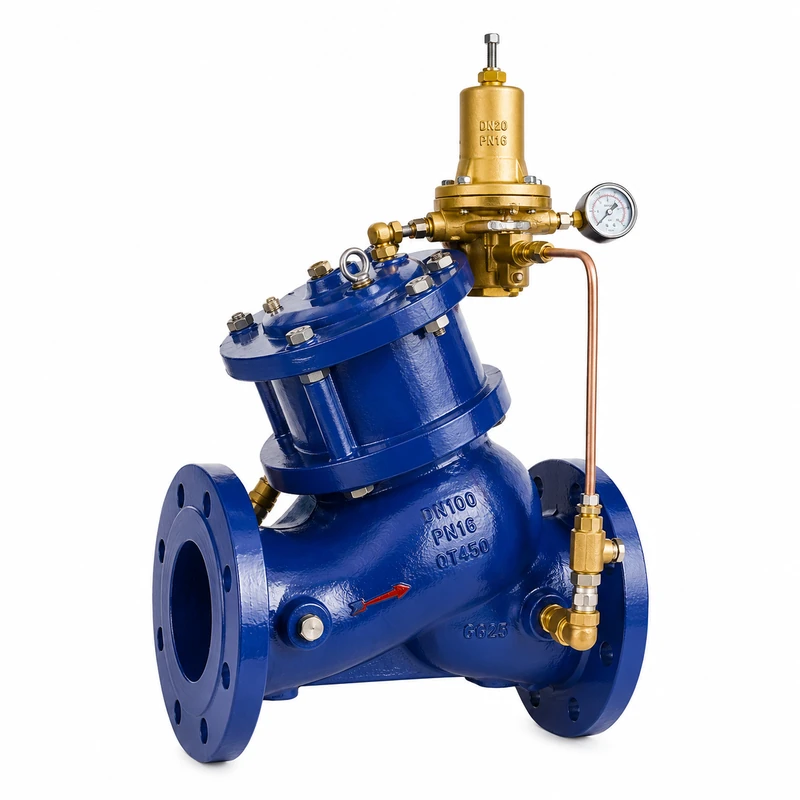
A pilot-operated regulator uses a small pilot to change the loading pressure on the main valve. This can reduce the pressure deviation needed to move the main valve, but performance depends on the selected design, available differential and condition of the pilot passages. Compare manufacturer curves for the required operating range.
- Key Features:
- Can reduce operating pressure deviation when properly selected.
- Requires checking pilot supply, differential and fluid cleanliness.
- Pilot operation and the number of reduction stages are different classifications.
4. Back Pressure Regulators
A back-pressure regulator controls upstream pressure by adjusting outflow. Rising upstream pressure makes it open further; falling pressure makes it throttle toward closed. See the back-pressure operating cases and selection checks for the pressure band, discharge conditions and flow data to specify.
- Key Features:
- Regulates upstream pressure.
- Normal pressure regulation does not establish abnormal-overpressure protection.
- Common in chemical and water treatment industries.
Relief Valves: A Separate Protective Function
A relief valve assigned to overpressure protection has a different duty from a regulator controlling normal operating pressure. Its selection must address the credible overpressure event, required relieving capacity and discharge conditions. A regulator’s self-venting feature or its ability to open on rising pressure is not evidence that it is a suitable protective device.
- Key Features:
- Selected for a defined overpressure-protection duty.
- Requires appropriate capacity and discharge arrangements.
- Cannot be replaced by a process regulator without evidence of suitability for that protective function.
Functions of a Pressure-Reducing Regulator
A pressure-reducing regulator supplies a lower controlled pressure to downstream users. The following functions apply to that duty; back-pressure regulation controls the opposite side. Actual outlet pressure varies with the selected regulator and operating conditions.
Here are the key functions of a pressure regulator:
Pressure Reduction:
The regulator reduces a higher supply pressure to the pressure required by the downstream process, within its operating limits. This normal setting does not establish protection if a failure could expose downstream equipment to excessive supply pressure.
Controlling Outlet Pressure Within an Acceptable Band
The regulator responds to changes in outlet pressure, but the final pressure can shift with flow and inlet pressure. Define an acceptable pressure band and check the flow curve and supply-pressure effect against it.
Flow Adjustment Based on Demand:
A fall in downstream pressure generally calls for more opening; a rise calls for less. The regulator controls pressure by changing flow. It is not a constant-flow controller, and it cannot restore pressure once available capacity or supply differential is insufficient.
Compensating for Supply Pressure Fluctuations:
As supply pressure changes, the balance of forces can shift the outlet pressure. Evaluate the manufacturer’s supply-pressure effect over the full expected inlet range. Two-stage reduction can help reduce this effect; it still needs to meet the required flow range.
Enabling Precise Control:
Where small pressure deviations affect the process, specify the acceptable variation during a demand change and after settling. Compare the selected regulator’s performance data with that requirement; labels such as “precision” do not define a universal accuracy.
Choose the controlled point before selecting the sensing or loading mechanism. These normal operating duties require different flow responses:
| Duty | Pressure being controlled | Response and separate checks |
|---|---|---|
| Pressure reduction | Downstream line or user | Admit more flow when controlled pressure falls; check flow-dependent droop, supply-pressure effect and lockup |
| Back-pressure regulation | Upstream vessel or line | Open the discharge path as controlled pressure rises; check destination pressure and available outflow |
| Nitrogen blanketing | Tank vapor-space pressure | Supply nitrogen as tank pressure falls; a separate vent arrangement may handle normal pressure rise. Coordinate operating setpoints with the independently assessed tank pressure/vacuum protection |
Blanketing supply, normal vent control and protective relief are separate functions. The self-operated control valve category provides construction options; it does not establish the complete tank-protection arrangement or a project-specific setpoint.
How to Choose the Right Pressure Regulator
Selecting the correct pressure regulator is crucial for optimal system performance. The following factors should be considered when choosing a regulator:
1. Application Type
The application type determines the specific requirements for the pressure regulator. Each type of system (such as pneumatic, hydraulic, gas, or liquid) will have different needs for pressure regulation.
- Pneumatic Systems: Typically require regulators designed to handle compressed air or gases. Regulators for these applications are often used to control air pressure for tools, machinery, or automation systems.
- Gas systems: Specify gas composition, pressure, temperature and cleanliness requirements. Oxygen, flammable and other hazardous gas services require a design and preparation suitable for that service; accurate normal regulation alone is not overpressure protection.
- Industrial applications: Regulators control process pressure by adjusting flow. They should not be specified as constant-flow devices merely because they influence the flow rate.
- Food, beverage and pharmaceutical services: Identify the required hygienic construction, wetted materials, cleaning conditions and applicable documentation for the actual process.
Key takeaway: Knowing the exact application will help you choose a regulator that is suited for the media (air, gas, liquid) and the operational conditions.
2. Pressure Range and Capacity
Separate the adjustable control-pressure range from the maximum permitted inlet and outlet pressures. State the required setpoint, allowable deviation and minimum and maximum pressures on both sides. Identify gauge or absolute pressure explicitly.
- Inlet Pressure: This is the pressure coming into the regulator from the source. It may vary, depending on the system’s pressure fluctuations. Ensure that the regulator can handle the maximum possible inlet pressure.
- Controlled pressure: For reducing service, state the required downstream pressure band; for back-pressure service, state the upstream band. Check the operating curve across the expected flow and opposite-side pressure range.
The capacity of the regulator is related to the flow rate and the volume of fluid or gas it can control at the required pressures. It’s essential to select a regulator that can maintain stable pressure even when the system’s demand fluctuates.
Confirm the control range and component pressure limits separately. Evaluate abnormal pressure exposure and the required protection arrangement; the normal setpoint is not a safety limit.
3. Flow Rate Requirements
Provide minimum, normal and maximum flow at the corresponding pressures and temperature. For gas volume units such as CFM or L/min, state whether the volume is actual or referenced to standard conditions, and give the reference pressure and temperature.
- At maximum flow, check that the regulator remains within the permitted pressure band at the lowest available differential; rated maximum capacity alone is insufficient.
- At low or zero demand, check the selected design’s low-flow behavior and, for a reducing regulator, lockup. These conditions can differ from the normal flowing setting.
It’s also important to understand whether the regulator will be handling intermittent or continuous flow. Some regulators are designed to handle fluctuating flow demands, while others are more suited to steady-state processes.
Key takeaway: Ensure the regulator’s flow capacity matches the expected demand, as inadequate flow rates can result in inconsistent pressure regulation and system inefficiency.
4. Material and Construction
The materials used in a pressure regulator’s construction must be compatible with the operating environment and the type of fluid or gas being regulated.
- Corrosion: Check compatibility of all wetted parts with the fluid composition, concentration and temperature. Stainless steel is not a universal solution for corrosive service.
- Temperature: Use the selected assembly’s pressure-temperature limits, including the diaphragm, seat and seals. The body alloy alone does not establish the complete regulator’s temperature capability.
- Special gas service: For oxygen or other reactive service, confirm the regulator’s stated suitability, cleaning and handling requirements. Material compatibility alone does not establish safe oxygen-service use.
Key takeaway: Select a regulator made from materials that ensure compatibility with the gas or fluid being controlled and can withstand the environmental conditions (e.g., temperature, pressure, corrosion).
5. Regulator Type
There are several types of pressure regulators, each designed to meet specific system needs:
- General-Purpose Regulators: These are typically used in non-specialized industrial or commercial applications where precise control of pressure is less critical. They are easy to install and adjust.
- Precision Regulators: These regulators offer more accurate control and are ideal for sensitive equipment that requires stable pressure. Industries like pharmaceuticals, aerospace, and laboratory research often use precision regulators, where even small variations in pressure can have significant consequences.
- High-Flow Regulators: These are designed to handle larger flow rates, making them ideal for applications that require the movement of large volumes of fluid or gas, such as in power plants or large-scale manufacturing.
- Dual-Stage Regulators: These regulators provide two stages of pressure reduction, which helps maintain a more stable outlet pressure even when there are fluctuations in the inlet pressure. Dual-stage regulators are often used in high-demand applications, such as gas distribution systems.
Compare the required pressure band, flow range, inlet variation and response with model-specific data. A general-purpose, precision or high-flow label does not settle the choice. Swagelok’s regulator selection guidance shows why sensing, loading, materials and operating requirements must be considered together.
Conclusion
Choose the controlled side first, then the construction and reduction stages that meet the operating cases. Check the flow curve, supply-pressure effect, materials and pressure limits. If remote setpoints or coordinated process control are required, compare the complete regulator arrangement with an externally actuated control loop.
Use the controlled-pressure duty and operating curves to compare actual regulator configurations before ordering.