

Mining and Slurry Valves Selected Around the Wear Mechanism
Particle size, solids concentration, settling, velocity, pressure drop and chemistry determine whether a valve controls the flow, plugs or loses its seat. MacoTango matches the duty to a modulating or isolation valve only after these conditions are reviewed.
Review valve selection against solids data, pressure drop, wear mechanisms and maintenance requirements.

Solve the Failure Mechanism Before Selecting a Slurry Control Valve
A mining slurry control valve can pass the calculated flow and still fail from local wear, solids packing, unstable travel or excessive restart load. Selection must therefore match the slurry, operating range, wear mechanism, shutoff duty and actuator as one control-valve package.

The Required Flow Is Achieved, but the Throttling Zone Wears Through
Wear is usually concentrated at the throttling jet, seat, closure member or outlet rather than spread evenly through the valve. Particle size, hardness, solids concentration, velocity, impact angle, corrosion and pressure drop all change where damage develops.
Selection response: Check minimum, normal, maximum and upset cases together, keep normal operation in a usable travel range, compare maximum particle size with the real minimum passage, and select flow direction, seat arrangement and materials around the expected wear zone. See the control valve sizing guide.
Mining Slurry Control Valve Selection Guide
Settled Solids Plug the Flow Path or Overload the Valve at Restart
Thickener underflow and concentrated tailings can settle during shutdown and create a much higher breakaway load than the running load. Narrow passages, pockets and dead zones can retain solids even when the valve operated freely during a clean-water test.
Selection response: Prefer a low-retention rotary path when the duty permits, document minimum passages and clearances, review orientation and shutdown time, define flushing or drainage, and size the actuator for the worst restart torque or thrust. For delayed or jumping movement, use the control valve stiction and sticking guide.
Control Valve Stiction & Sticking GuideCyclone-Feed Pressure or Slurry Flow Remains Unstable
High solids, pulsation and velocity make an oversized valve especially difficult to control. If normal production stays near the seat, small movements can create large flow changes and a concentrated erosive jet even though maximum Cv is sufficient.
Selection response: Size paired flow, inlet pressure and outlet pressure cases using slurry density and the stated rheology basis, then compare required Cv with predicted opening and the installed characteristic. For non-Newtonian or gas-entrained slurry, state the correction method and uncertainty instead of treating clean-liquid Cv as an exact prediction.
Control Valve Sizing Guide
Tight Shutoff Can Conflict with Solids Passage and Control Stability
Small sealing clearances can trap particles or damage a soft seat, while a larger metal-seated passage may tolerate solids better but provide different leakage and low-flow performance. Continuous throttling and positive isolation are not automatically the same duty.
Selection response: Define the required leakage class, the consequence of leakage and whether the control valve must also isolate the line. If positive isolation is essential, use a separate isolation valve selected for that function rather than forcing one throttling valve to satisfy incompatible requirements.
Slurry Control Valve Selection Guide
Corrosion and Abrasion Attack Different Valve Components
Acidic mine water, leach liquor and reagent streams can corrode one component while suspended solids abrade another. A material that looks suitable in a static corrosion table may fail when particles remove a passive film or damage a polymer lining.
Selection response: Review body, closure member, seat, shaft or stem, packing, gasket, hardfacing and lining separately against chemistry, temperature and solids. For combined corrosion–erosion duty, verify both chemical compatibility and mechanical wear resistance. See the severe-service control valve guide.
Severe-Service Control Valve Guide
Repeated Trim Replacement Consumes the Maintenance Window
At remote mine sites, flushing, lifting, removal and waiting for model-specific parts can cost more than the damaged component. A technically suitable valve still needs an inspectable wear baseline and a practical parts strategy.
Selection response: Identify likely first-wear surfaces, define replaceable seats, closure members, bushings, liners, packing and gaskets, and record model, serial number, material and revision. Inspection triggers can be tied to leakage, travel deviation, torque or thrust change and measured wear. See the control valve spare-parts guide.
Control Valve Spare-Parts Guide
Send the Slurry Data and Operating Cases Before Final Valve Selection
Provide minimum, normal, maximum, start-up, flushing and upset cases with matched flow, inlet pressure, outlet pressure and temperature. Include slurry density, solids concentration, D50/D90, maximum particle size, hardness, rheology or viscosity, settling tendency, chemistry and pH.
Also confirm: Shutoff and fail action, pipe orientation, shutdown duration, available flushing, actuator supply and stroking time. For replacement valves, add current model, actual travel, wear photos, damage location, service hours and replaced-part history.
Prepare a Mining Slurry Valve ReviewMatch Each Mining Control Duty to a Published Control-Valve Product
There is no single “best slurry valve.” The starting point changes with solids loading, particle size, rheology, pressure drop, chemistry, operating range and shutoff duty. Final size, trim, materials, actuator and accessories remain conditional on the project data.
Engineering starting point: Match the valve to the failure mechanism first, then verify particle passage, Cv and travel, wear location, torque or thrust, shutoff and maintainability before technical approval.
Abrasive Mineral-Slurry Flow and Cyclone-Feed Pressure Control
Start with an eccentric hemisphere control valve when solids passage, rotary throttling and local wear control are more important than a narrow globe-valve flow path.
- Verify before selection: Cv and predicted opening at each case, D90 and maximum particle size versus minimum passage, velocity, wear zone, dynamic torque, leakage and replaceable wear parts.

Electric Eccentric Semi-ball Valve
Electric eccentric semi-ball valve for reliable industrial flow control and shut-off, with flanged ends, multiple sizes, pressure classes and materials.
Thickener Underflow, Concentrated Tailings and Restart After Settling
The eccentric hemisphere valve is an engineering starting point where a more open rotary path is useful, but high-solids or paste-like slurry must be checked against rheology, settling and restart load.
- Verify before selection: Yield stress or rheology, shutdown time, settled-bed risk, flush or drain availability, worst-case breakaway torque, minimum controllable flow and particle-passage margin.

Eccentric Hemisphere Valve
A more open rotary starting point for abrasive mineral slurry, tailings and solids-bearing throttling.
Process or Reclaimed Water with Fine Suspended Solids, Fibres or Scale
Use a V-port control ball valve for lower-solids streams where characterized rotary throttling and wiping or shearing action are useful. It is not the default for coarse, dense or rapidly settling slurry.
- Verify before selection: Notch and Cv curve, normal opening, particle size, solids level, seat material, differential-pressure torque and allowable leakage.

V-Port Control Ball Valve
V-port ball valve offers precise flow control, excellent throttling performance, and high Cv accuracy for industrial process regulation.
Flotation Feed, Froth and Reagent Service
Use a V-port control ball valve for lower-solids flotation flow and a small-bore single-seated globe control valve for substantially solids-free reagent dosing. Gas entrainment, mineral solids and reagent chemistry must be reviewed separately.
- Verify before selection: Solids level, expected gas fraction, whether gas is stable or intermittent, minimum dosing rate, density, pressure drop, Cv-versus-opening, chemical compatibility and required control range.

V-Port Control Ball Valve
For process or reclaimed water with fine suspended solids, fibres or soft deposits where characterized throttling is required.
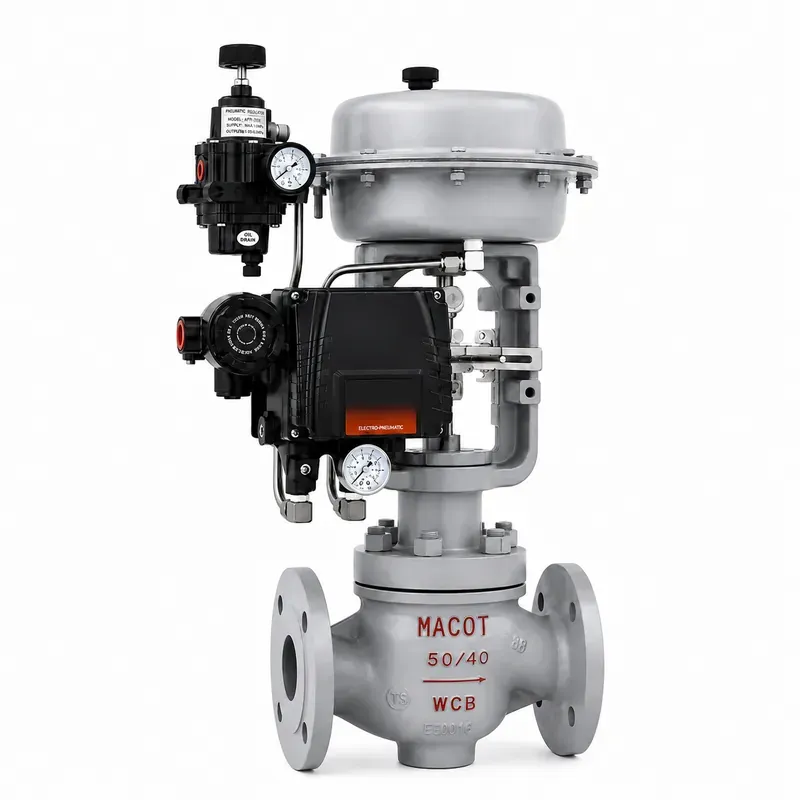
Small-Bore Single-Seated Globe Control Valve
For substantially solids-free reagent dosing and other low-flow duties that require a small rated Cv and repeatable travel.
Corrosive Leach Liquor or Reagent Flow with Little or No Abrasive Solids
A PTFE-lined globe control valve is a candidate when corrosion is the governing mechanism and abrasive solids are minimal. Do not treat a corrosion-resistant lining as evidence of slurry abrasion resistance.
- Verify before selection: Every chemical constituent and concentration, operating and cleaning temperature, pressure or vacuum, permeation or swelling risk, Cv and travel, and seat leakage.

PTFE-Lined Globe Control Valve
For highly corrosive liquid with little or no abrasive solids after full chemical and lining checks.
Large-Flow Corrosive Mine Water or Low-Solids Leach Service
Evaluate a fluorine-lined control butterfly valve for larger-diameter corrosive liquid lines when abrasive solids are limited and the required flow can be controlled within a suitable disc-angle range.
- Verify before selection: Liner chemical and temperature limits, pressure and vacuum, solids size and hardness, Cv and opening at minimum/normal/maximum flow, disc angle, dynamic torque and shutoff.

Fluorine-Lined Control Butterfly Valve
For larger lower-pressure-drop corrosive liquid lines where abrasive solids are limited and disc-angle control is suitable.
High-Pressure Mine Water or Clarified Process-Liquid Letdown
Use a multi-stage high-pressure-drop globe control valve for clarified mine water where liquid pressure reduction, cavitation or flashing risk—not solids passage—is the governing problem. Any solids-bearing case still needs explicit passage and plugging review.
- Verify before selection: Minimum, normal and maximum pressure cases, vapour pressure, cavitation or flashing risk, stage passages, outlet velocity, material compatibility, actuator thrust and actual solids content.
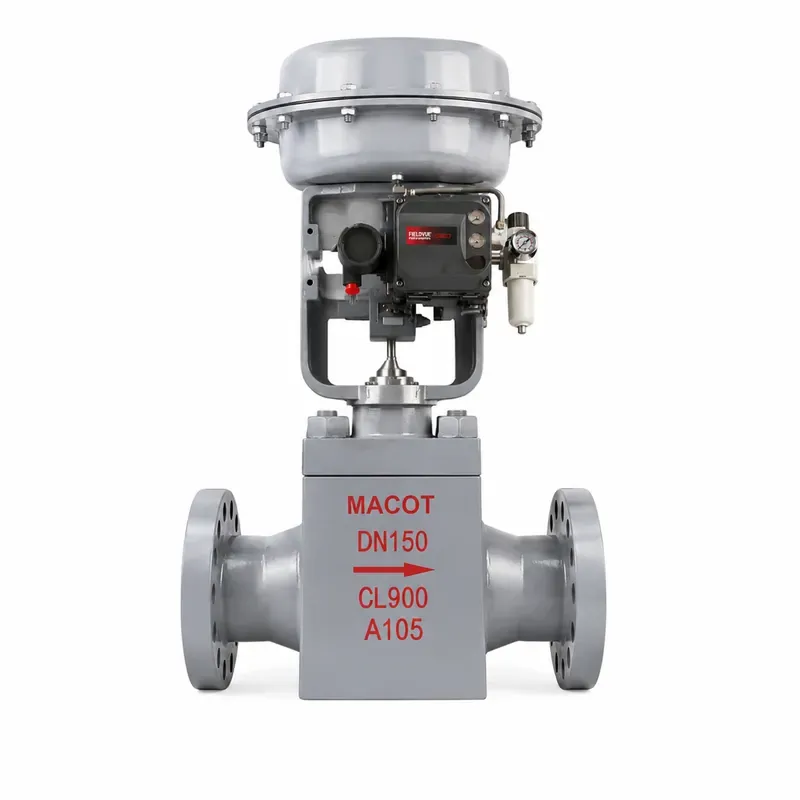
Multi-Stage High-Pressure-Drop Globe Control Valve
For clarified mine water or process liquid where staged pressure reduction is required and the trim passages remain compatible with fluid cleanliness.